Tuesday, 14 August 2012

Old Wardour Castle


5th August 2012 

If you want to see the big picture, you're going to have to go to Google maps :-)
So, to help Cal get over her jet lag it was off for another adventure outside – hopefully there would be some sunshine to help. So, the dilemma: what was close to Salisbury that we had not visited yet, and that would be interesting enough not to put Cal to sleep? And the answer: Old Wardour Castle – just 15.7 miles from home (if you travel with Google, and type in “Old Wardour”) or 17.8 miles and an extra few miles of twisty mazes and passages on single track roads . . . if you use the prescribed postcode (SP3 6RR), hmmmm, too bad.
Along the way we passed through Ansty – a place where Cal’s Mum has a friend – so we had to stop and look at the swans and cygnets on the pond in the middle of the town. 

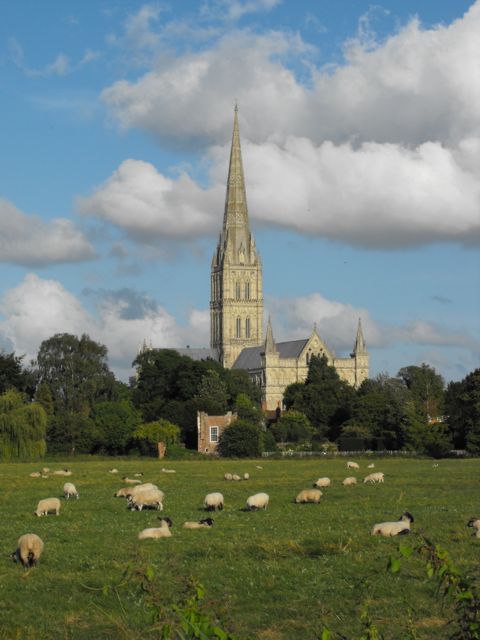
Old Wardour Castle, near Tisbury was built in the 14th century as a lightly fortified luxury residence for comfortable living and lavish entertainment. The castle was badly damaged in action during the English Civil War in the mid 17th century, and then rather than being rebuilt, was turned into a “romantic ruin” as part of the landscaped 18th century grounds of New Wardour House. The castle was used in the move Robin Hood Prince of Thieves (think as the ancestral castle of Robin, that was destroyed whilst Robin was on a Crusade).

So, the above paragraph was the abridged history (with a modern day anchor with Kevin Costner). For those interested in the history just read on. For those that aren’t, just look at the pretty pictures :-). The above picture doesn’t really do justice to the state of the castle, which is really not that bad (all things considering – we were able to get to the top of the tower!!)
So, we got to the castle just in time for a quick bite to eat (along with a Fredo Frog and a Caramello Koala – recent arrivals with Cal). After that it was off for an explore of the “romantic ruin”.
 The original castle dates back to 1392 when Baron Lovell was granted permission by Richard II to build a castle. It was inspired by the hexagonal castles that were in fashion in France, but this is the only one in Britain – it is also unique for the fact that it has several self-contained guest suites (luxery!!!). After a falling out with Richard III (don’t mention the word treason), the castle was confiscated (he just wanted the guest suites). It was passed to Sir Thomas Arundell in 1544, who became the 1st Lord Arundell of Wardour (OK, so he had to buy the castle). The Arundells were staunch Roman Catholics (and wealthy land owners), so they were naturally Royalists in the English Civil War.

 
During that conflict, in 1643, Thomas Arundell, (the 2nd Lord Arundell) was away fighting for the King when his wife, Lady Blanche Arundell, aged 61, had to defend the castle with a garrison of 25 men against 1300 Parliamentarians. The Parliamentarians used guns on the walls and attempted to undermine them with mines. After five days the castle was threatened with complete destruction and Lady Blanche agreed to surrender. In the mean time, Lord Thomas Arundell had died of his wounds after the Battle of Lansdowne, and his son, Henry, now the 3rd Lord, less than a year later, laid siege to his own castle, reluctantly blowing much of it up and caused the Parliamentary garrison to surrender. No wonder there was so much destruction.


After the return of the monarchy, rather than rebuild the castle, the family decided to build a new “castle” (actually, in stylistic terms, the New Castle is not a castle at all, but a symmetrical neoclassical country house with a main block built around a central staircase hall and two flanking wings . . . thank you Mr Google and Wikipeadia – I’d never have made that up :-)). You can see the “new” castle from Old Wardour.
 

Back to Old Wardour . . . which was left as an ornamental feature in the surrounding parklands – designed by Capability Brown, a very much renowned 18th century landscape gardener . . . well, don’t forget the scale was a bit different, we’re not talking about a ¼ acre block, rather tens of acres. We also finally discovered that “Capability” Brown’s real name was Lancelot Brown – who was nick named Capability, for his ability to use the natural features of the surroundings. His gardens are in some of the most amazing places, Blenheim Palace, Hampton Court Palace, Kew Gardens, Warwick Castle, Chatsworth . . .


One last little titbit. In the late 1800’s the kids of one of the Lords used to dress up as commoners and act as guides to the ruins – charging the tourists to take them around. The boys used to share the spoils, whilst the sister got nothing except pinched cheeks (used to make her look more gaunt or some such thing). Of course it wouldn’t be complete without a few photos with flowers in them.
After Old Wardour, it was off for a half pint at a Badger pub in Shaftesbury (to get our books stamped), followed by at least another pub on the way home (for more stamps) . . . the memory is a bit flakey along the way :-).

St Clements Danes

The last of the"home alone" series

St Clements Danes, London

3rd August 2012
The High Commission (Gringot's Bank) from St Clements Danes
Friday saw Mark in London for work rather unexpectedly. I had to review a DSTO report, and the only location I could do so was at the High Commission in London. After starting work at 6 am to catch up with people in Australia it was off to London on the “cheap” off-peak train of £40. Directly opposite the High Commission, is St Clements Danes – the Central Church of the Royal Air Force. The site of the church also once held the tomb of the Saxon King Harold Harefoot d.1040 – but alas, no more. This is hardly surprising when you think of the history of the church.
     
St Clements Danes from the High Commission

In the 9th century, Danes who took English wives were allowed to settle in the area, and subsequently took over a small church dedicated to St Clement (and was then known as St Clements-of-the-Danes). St Clements himself was martyred at the end of the 1st century by Emperor Trajan, who had an anchor tied to St Clement and then had him thrown into the sea. The fire of London in 1666 did not destroy the church, but it was in such poor condition that Christopher Wren was invited to rebuild it (1680-1682). On 10th May (Cal’s birthday) 1941 the church was bombed with an incendiary, and whilst the walls remained standing, the church was gutted. It was eventually restored and re-consecrated in 1958.


The relationship to the RAF started at the end of the Second World War, when it was suggested to the diocese of London that the RAF be permitted to rebuild a church as its own. And so, St Clements Danes, destroyed by the actions of the German Air Force, was given into the care of another air force. The role of the church is two fold – to be a place of worship, and a place to commemorate those who died whilst serving in the RAF. On the floor of the church are almost 900 squadron and unit badges of the RAF, made from hard Welsh slate. There is a book of remembrance in which the names of over 150,000 men and women who died whilst serving in the RAF.

Monday, 13 August 2012

Car Troubles

Don't you love Google Maps?
No doubt many are aware now about 3 miles from Heathrow on the way to pick up Cal, our car engine died - just on the on ramp to the M4 from the M25. The oil light came on just as I was exiting the M25 and . . . "bang" many clunkings and reduced power later . . . off on the side of the road. It took some time to get a tow, but the tow truck did drop me off at Heathrow, so that was good. At the end of a long flight, this was just about the end for Cal. We ended up hiring a car to get home, but at least we got home, had dinner and sent Cal to bed for some much needed sleep.
 
View from the stranded car . . . the M4 on ramp
Initially we had no idea what the damage was going to be . . . we have a better idea now. After getting word that the car was ready to be picked up, Mark got on a train to travel up to London. It looked only like a new oil pump, but there was still an abnormal noise in the engine that we would monitor. Anyway - more than halfway to London (Woking) Mark received a phone call from the garage to say that they'd just test driven the car (what . . . you sent me to London to pick it up without taking it for a drive??) . . . and they found that we'd also blown the turbo. A slow u-turn at Woking and it was back to Salisbury £25 and 4 hours poorer. Hopefully with the turbo fixed that will be it. The really good news is that the warranty company has acknowledged that it is their responsibility - we just have a £70 excess - whew.


Salisbury Cathedral from near the Old Mill
Salisbury Cathedral from the town path
A view of the town path
One silver lining in the cloud is the fact that Mark is now forced to get some exercise - has to walk into Salisbury to get the bus out to Porton down - there are only three in the morning (0730, 0800 and 0830) and two back in the evening (1650 and 1800). OK, so Mark could also catch the number 5 bus from about 200m up the road, but then there is no exercise. The walk is via the town path (and the Old Mill). The Cathedral is always a wonderful sight - it is truly a beautiful building - the view takes you back in time about 500 years - no cars or civilization in sight - just the water meadows, the sheep and the cathedral. Takes you back to the days of Constable from Bishop Fishers Grounds.

Salisbury Cathedral in the early
morning light from the town path
Constable's Salisbury Cathedral
from the Bishop's Garden


A view of the Old Mill in the early morning
On the way home from the aborted London trip, the only thing that stopped Mark from enjoying a quiet pint at the Old Mill (maybe a pint of "Old Speckled Hen") before facing the final 1/2 mile was that he gave Cal all the cash left in his wallet cash to get into the hospital (X-rays on her knees) . . . Oh, and maybe the fact that a warm beer is fantastic - except when you've been walking hard. a relaxing pint by the water would have been good though :-)

Here's to X-rays that show what's wrong with Cal's knees, and that it can be readily looked at.


Friday, 10 August 2012

Home Alone Continued

Well, Even though Cal is home, I thought I'd finish the Blogs of stuff I did while she was in Aus.

Figsbury Ring

23rd July 201
After work I headed to a National Trust site called the Figsbury Ring. It is an historical site that has yet to be fully understood. It seems that the site dates back to the Neolithic period as some sort of enclosure. The historians think that further work occurred in the late Neolithic period to make the site a henge, with a later Iron Age ditch around the outside. Whatever the origin, apparently there is evidence that the site was occupied from about 3000-2500 BC. Irrespective, the cows still enjoy the site as they do at Badbury Rings, and there are also plenty of summer wild flowers.
The site is on my way home from work – it may look like a detour, but I guarantee that the long route has by far the better roads and is less time consuming. Home is at (A); Work is at (C); and the Figsbury Ring is at (B). 


Once again there were a bunch of cows – but ignoring them, you could just make out the spire of Salisbury Cathedral in the distance. It was pretty tricky setting up the camera with no tripod, and a quick run town the ditch to get into picture, but it worked (sort of).
Mark in the first Ditch
Salisbury in the Distance
What is it about cows and Iron Age Rings?
  The panorama shows both the inner and outer ditches
And last but not least, some of the wild flowers - I gotta say, blogging doesn't help with photo layout :-(


The Woodford Valley

28th July 2012

What was I thinking - some sort of "hero" walk while Cal was in Aus?? You would have thought that easing gradually into a long walk would be the sensible thing to do, but no, "hero time". Mind you, I did give myself a get out of jail free card. The walk from Old Sarum up the Woodford Valley was about 8 miles (13 km), which was only about twice as long as my Badbury Ring stroll, so I thought "what the heck". The plan was to take a bus back to Old Sarum if all was not good (so not that much of a hero :-)). Anyway, for reasons that will become apparent, it ended up being a return walk, and I was mighty glad to see the car :-) The map to the right shows the one way trek from Old Sarum to Stone Henge - well just north of the Henge as I was more interested in the Barrows along the way than the Henge itself - Cal and I have been there a couple of times, and a busy Saturday afternoon was not my idea of fun. As it was, I had the barrows all to myself :-).

The Walk started from the Old Sarum car park, and pretty soon it looked like a road going on forever. I was very much reminded of Tolkien's Lord of the Rings (first book) "the road goes ever on"

The Road goes ever on and on
Down from the door where it began.
Now far ahead the Road has gone,
And I must follow, if I can,
Pursuing it with eager feet,
Until it joins some larger way
Where many paths and errands meet.
And whither then? I cannot say.


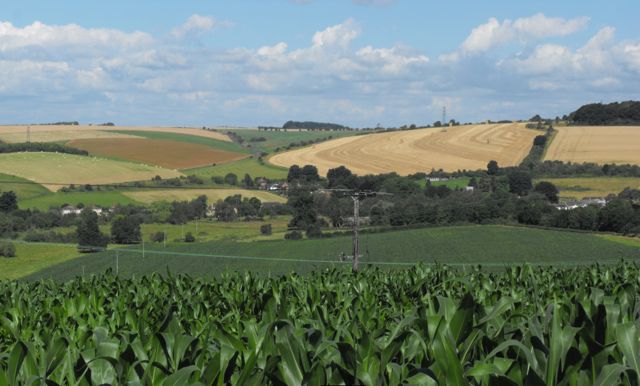
The Woodford Valley wasn't living up to it's reputation as a valley - but then I was walking on the tops of the hills looking down into the valley. 


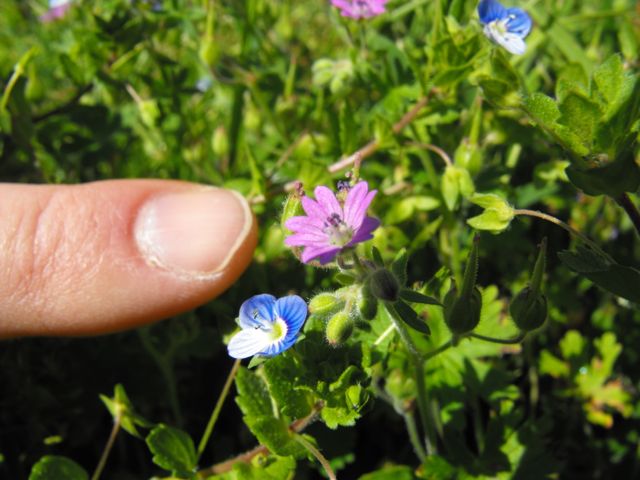
There were also a bunch of summer wild flowers - and I couldn't help myself :-)


I found myself walking past wheat fields, and then eventually past piggeries. Man, they smell bad enough when you're driving past them half a km in the distance - try walking right along side of them. One of the thoughts that keep me going was the fact that bacon tastes soooo good, and I'd had a good helping of bacon and eggs that morning :-) (Sorry Sarah - it's who I am). Not only did the pigs smell baaaaaad, but they were also engaging in some, hmmm, how does one put this delicately . . . hmmmm, nope, I can't. There were pigs bonking every where I looked - I couldn't escape it. (But Cal wouldn't let me post the pictures).

Eventually the path led down from the "ridge" line into the valley floor at a village called Great Durnford. As I wandered down, the locals were mowing the cricket ground (complete with dogs in tow - I love it). It was probably in anticipation of the fact that there was no rain forecast, and they might actually get some cricket in during the afternoon. Past the pub, and a lovely thatched cottage, past the swans and onto the footbridge over the river.


That's where I lost my sun glasses - darn - the unique clip-ons to prescription glasses - NOT happy Jan. This is the reason why I decided to walk back - Whilst I search the path twice, I thought I'd give it one more pass on the way home, but alas, no success.


From the Valley floor it was through a woodland to the the Normanton Downs, which are fairly plastered with barrows - all on private land, so all you can do is look at the sheep as they gallivant all over the mounds. With Stonehenge (and the tourist buses) in sight, half my journey was done. I kept walking past the Henge to the Cursus downs, where there are about (lots of) barrows that you can walk up to, and over if you are so inclined (I wasn't). I just had my lunch whilst taking in the sunshine :-) and scene.


On the way home I decided to fore go the steep walk out of Great Durnford, and took an alternate path (almost missed the overgrown path entrance) that by-passed the piggies and took me along a more gentle route. Very soon I was walking back down the original path an thinking that my meet were sore, and the pub looked good. If you know your Tolkien you might recognise the difference in attitude between the first and third books. OK, so I embellished a little :-)

The Road goes ever on and on
Out from the door where it began.
Now far ahead the Road has gone,
Let others follow it who can!
Let them a journey new begin,
But I at last with weary feet
Will turn towards the lighted (Badger) inn,
My evening-rest and sleep to meet.

And now for the Badger Inns (plural) in Gillingham :-)