Sunday, 8 July 2012

London

6th July

Just a very short blog.

On Friday Mark went up to London - it doesn't happen all that ofter, but regularly enough. The meetings were at the Australian High Commission on Strand, and opposite the AHC is St Clements Danes church, which the the home church of the RAF. Anyway, I got there just after 12 noon, and the bells of St Clements were peeling out a familiar tune . . . "Oranges and lemons, the bells of St Clements". The reason I mention St  Clements, is that there is a dead king there :-) Harold Harefoot who died in 1040, so after my meetings I was going to pop over and take a look. Unfortunately, the church was closed (very unusual for 4pm) as most churches are open during the day.

SO, it was off to Fortnum and Masons for some special supplies. Royal Blend tea for Cal - they didn't have the 50 pack, so 2 x 25 would have to do (strike 1). Some White tea for Mark (yum) - no luck, no white tea of any form (out of season, the man in tails and waistcoat said - and who am I to argue with that?)(strike 2), but the man managed to convince me to buy some orange tea . . . very good value he said . . . at £400 per kilo (ouch) - I got £8 worth. Then off to the truffles section for some (more ouch) value for money . . . a bargain at only £100 per kilo . . . each truffle cost a pound. They didn't have any classic white chocolate (for Cal of course)(strike 3).

This time I took a camera, just in case (when I go to London I rarely buy a tube ticket as I rarely tire of the sights of one of the classic cities in the world). I did not take a brollie for justin as the BBC weather said it was going to be fine - bollocks - I'm not going to be caught out again. Anyway - one photo for the blog, taken from Waterloo Bridge on the way back to the train station - don't be fooled by the blue sky - it was black as sin behind me. Speaking of weather, the Royal International Air Tattoo (RIAT - best airshow in the UK) was on this weekend. The weather on Saturday was real bad, so I didn't go - today was supposed to be no better, but it is not that bad . . . darn. There's always next year (with a better camera :-))


Thursday, 5 July 2012

Lazy Days


Lazy Days

Old Sarum

Saturday 19th May
By this time we were staring to get a little tired (what already?) – we think it must be either jet lag catching up, or the fact that it doesn’t really get dark til after 10:00pm, and then light at about 4:30am to 5:00am.  Maybe there is an annual body bio-rhythm as well as the diurnal one that normally gets screwed up with jetlag. Anyway – call it what you want . . . even sheer bone idle-ness ☺ we were tired and had a long sleep in, finally getting out of the house in early afternoon, and Old Sarum was the closest place (other than Salisbury itself).


In any event, it was good to visit Old Sarum before visiting the Cathedral given that Old Sarum was the original settlement in Salisbury – dating back to Neolithic times (about 3000BC). It’s been an Iron Age Fort, A Roman garrison, a Saxon stronghold against the Vikings, a Normal walled city and castle, and a Royal Residence (for William I and Henry I). In fact this is the site where William the Conqueror paid off his mercenaries, and where the Barons swore their allegiance. In 1217 there was no township at what is now Salisbury, just Old Sarum (well it was probably just “Sarum” then, not “Old” Sarum), and the castle, village and cathedral were all inside the walls. The soldiers did not treat the monks well, and the straw that broke the camels back was the soldiers locking the monks outside the gates on a very cold and nasty night. The Bishop got ticked off and got permission to build a new Cathedral at the present site. Very quickly, New Sarum (New Salisbury) became the place to be – Old Sarum was raided for building materials, and the rest is, as they say, history.


So, we wandered around the ruins – had a snack somewhere near what would have been the high alter of the cathedral, and generally just relaxed. Cal’s sharp eyes found some rabbits on the side of the old Iron Age fort walls – Cal just loves them here as they’re not feral.
 
So, this time Mark also remembered to look for flowers to capture close up with ruins in the background . . . there wasn’t much choice, but at least there’s something – even if it’s a buttercup with the old cathedral in the background. So, have a lovely blue coloured summer flower that grows in the grass as a complementary partner ☺.


Cliveden

Sunday 20th May
Having lived in the South West ten years ago, and as members of both English Heritage and National Trust, Cal had already sussed out and taken us to most of the well known, and really nice castles and houses in our local area. So, this time we went further afield, and headed off towards Marlow Country and Cliveden House. It also gave us an opportunity to catch up with Helen and Ray.


Cliveden was once the glittering hub of society, visited by virtually every British Monarch since George I and home to Waldorf and Nancy Astor in the early 1900s. The day we went to Cliveden was actually Nancy Astor day . . . She was married to some rich American (Waldorf) and she was also a member of parliament. Cliveden was renowned for hosting exclusive parties and political gatherings – very high society if you don’t mind. It also, later on, became infamously associated with the Profumo Affair.


Being Nancy Astor day, there were a few more people than normal, and a couple of extra events – there were some jazz and brass bands playing, and a smallish display of vintage and veteran cars. Cal liked the Triumph – not because it was a piece of classic English motoring history, but because of the colour. Mark like the Morgan ☺.   


The house is now a private hotel (also for the rich – the least expensive room starts at £385 per night not including breakfast or dinner – you can add another £195 for that. The House is a bit hard to get into (there are timed tickets to parts of the house), but the grounds are pretty good. They have a great maze – and yes, Cal did get lost in it, but we both made it to the centre (see the pic of Mark). It has a lovely formal garden (parterre), with lots of walks down by the Thames, and through the woodland. We didn’t venture down to the river, as it was down a steep incline, and Cal’s knees would not have coped at all.
 

OK - first of the "rude" statues


Mark in the centre of the maze
Here are the weird man-boobs


There were also some nice formal gardens – and this really weirdest of sculptures of men with boobs – I know there is a name for these – I think they were popular during the Jacobean era (James I), but I can’t be sure.


There were no flowers available to take a photo with the house out of focus – just couldn’t get one from the parterre, but there were some lovely flowers in the gardens. Once again we managed to find plenty of Rhododendron     


It was yet another freezing cold day, so Soup for lunch, and (for Cal) Creamed Tea around 3 pm. After this we headed off to say hi to Helen and Ray . . . and another afternoon tea. It was quite late when we headed off, so we stopped in at the de Havilland Arms for dinner. The fact that it is a Badger pub had no bearing on things – really. OK, so it was a Tanglefoot for Cal and a Hopping Hare for Mark. The landlord was also kind enough to give Mark the glass – Yes, scored again!!

SO, that's it for another blog from the UK. But, we were just wondering . . . is anyone reading these blogs?? If so, please consider saying hi, so that we know to continue ☺

Saturday, 30 June 2012

RNAS Yeovilton Air Day

Friday 22 and Saturday 23 June 2012


Air Show Magic is here !!!! Score one for the boys. Mark left Cal at home to play with her pussy cat, and went off to Royal Naval Air Station (RNAS) Yeovilton for a couple of days of big boys toys. Yeovilton is about 45 miles from home, an an easy drive for a couple of days of kerosene filled action.
 
RNAS Yeovilton – also known as HMS Heron – is one of the Royal Navy’s main air bases, and one of the busiest military airfields in the UK. The Fleet Air Arm have their operational and training Lynx helicopter squadrons and the Commando Helicopter Force are based there, along with (and most importantly for Mark) the RN Historic Flight, including their vintage aircraft such as Fairy Swordfish, de Havilland Sea Fury and the de Havilland Sea Venom.

Day one was really for the aircraft enthusiast nerds - it wasn’t part of the air show per se, rather a day when aircraft arrived from near and far, and for events. In that regard it was great. Instead of contending with about 40,000 people (give or take 10,000) there were only about 100 (give or take about 20)! We had great views of the practice events, the take offs and landings of the aircraft. All in all it was pretty good. There weren't many things that were lacking, but still, some very important ones.

First, and most importantly, none of the vintage jets were in the air, other than the arrival of the Jet Provost. (see right) This is actually the main reason for me going. Dare I say it? No I can’t quite bring myself to say it, but to be honest a modern fast jet cutting through the sky at 600 kts is just another fast jet (OK, so I did say it). On the other hand, the classic jets are very special. They cost a bomb to keep flying, and there are only a handful flying around the globe - sometimes only one of a kind! So I don’t mind spending money at the website www.vulcantothesky.org/

Gotta get me some cuff-links, but they’re currently out of stock.

Second, the Battle of Britain flight only turned up on the air show day. I’ve seen this a few times now, and it is always a special flight. Cal and I watched a doco called the “Who Betrayed the Bomber Boys” - a fascinating story about how the RAF Bomber Command was treated towards, and after the end of the second world war. Whilst there will always be some degree of controversy regarding massed bombing raids, there is no doubt as to the courage of the aircrew . . . knowing that your chances of surviving a tour of 30 missions were only 17% - not good odds whichever way you look at it. The Queen unveiled the first memorial to Bomber Command yesterday (Thursday 28th June http://www.bbc.co.uk/news/uk-18633791) in Green Park, London, honouring the 55,573 men who died in bombers during WWII. Anyway, whilst I mention this, I didn’t actually stay to watch the BoB flight. I was pretty tired at the end of the day and decided to beat the traffic and have an easy drive home (maybe I’m not such a die hard after all).

Third - there were no imitation (and real) explosions during the “command assault” demonstration. The RN did use real explosives (you could feel that in the chest) but also the Hollywood petrol explosions. OK - so the pic on the left was lifted from the web, but it is what happened on the day :-)


Here are the Helo's that I saw:

AH-64 Apache Longbow

Sea Kings - big honking helicopters!!

OK, so what was there to see? Lots :-) I was like a pig in mud!! Maybe I’ll just post some of the pics I took . . . BTW I REALLY NEED a better camera :-). Nonetheless, after culling out the really crap photos, I still have well over 600 pictures . . . so I just gotta get ruthless!! The main themes were:


Static aircraft - I’ll just add a few :-)

This is the French Rafale - the French really do know how to design sleek aircraft - have no idea about how good they'll be in combat tho'
Sea Fury - this is one mother of a piston engine aircraft - developed right at the end of  WWII
From left to right: Hawker Hunter - classic jet of the 60's, SOKO P-2, Sea Venom, P-40 KittyHawk

de Havilland Sea Venom - much like the Vampire

Fairy Swordfish
Gloster Meteor taxiing to runway

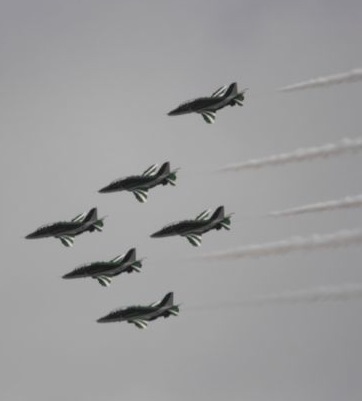
Flying displays - coordinated flights. That would be a few pics each from the Red Arrows, and a few from the Royal Saudi Air Force display team. It might be worth noting that the motto painted on the side of all their aircraft os “God Bless You” . . . conjures up all sorts of images in my head . . . “here, have a load of bombs . . . by the way . . . God Bless You!!”


Flying displays - single aircraft. Lots of these (I’ll limit the photos in the interest of not putting everyone to sleep).


This is the aircraft that Price Charles learned to fly on (Chipmunk - name of aircraft, not the Prince)

Saudi Hawks - they have a Red Arrows mentor on their team and it shows. I wish I'd photographed one of the pilots - a very resplendid Arab beard (no racism here!!) just the classic Arab beard. The thing that I don't understand is how the heck he gets his oxygen mask to seal . . . I have a short beard and still had to shave it off prior to my flight in an F/A-18 Hornet!!

Love this pic!!! pretty cool to imitate the wingtip vortices like this - well done Red Arrows


Classic aircraft in the air - the cream had to be the Fairy Swordfish (such a big aircraft (relatively)), the de Havilland Sea Fury, the de Havilland Sea Venom, the de Havilland Vampire, the Gloster Meteor . . . oh, I think that was nearly all of the classics that took to the air :-)

Sea Venom and Meteor - these guys have a lovely high pitch whistle of the gas turbine as they fly past

Sea Venom

Vampire

Fairy Swordfish (BTW - who, other than the Poms, would name a warplane manufacturer "Fairy"??)


Saturday, 16 June 2012

Dead Kings

WOW how time flies - it’s now mid June and we haven’t updated the blog since early May!! So much has happened - you’ll just have to catch up on facebook or skype (just kidding). 

I’m not certain if we’ve told many people, but we are in quest of visiting the resting places of English monarchs - well without kids we gotta do something. We were wondering (OK, so Mark was wondering) if we could visit all of them, starting with the Anglo Saxon/Kings of Wessex - King Egbert, who died in 839, and whose bones now lie in Winchester Cathedral and finishing with King George VI in St George’s Chapel at Windsor Castle. A quick Google search later revealed that we’d hit a problem with at least 9 out of 65 since these are overseas (mainly in France) but some are also lost to all time - e.g. in the fire of London that destroyed Old St Paul’s Cathedral where Ethelred the Unready was buried. 

There are a number of of the early Kings of Wessex sites sites near to Salisbury, so we headed off on Saturday 12th May in search of our first (King Edward, the Martyr, who died in 978, and was originally buried at Shaftesbury Abbey, Dorset). The next few entries might be a bit out of order as we just deal with the Kings - we’ll get back to the rest of the story soon. For information, I nicked the following picture that has the lineage of the Kings of Wessex to William the Conqueror from http://www.britroyals.com (so hopefully acknowledging this saves our copyright butts).


Shaftesbury

Saturday 12th May
The following map shows our path for the day - with Shaftesbury at “B”, Followed by Sherborne Old Castle and Sherborne Abbey at “C” and “D”. Along the way we revisited the Fovant stone badges, which date back to 1916 and include the Australian Army “rising sun” emblem - the kids might remember these as we visited them on the way to visit Sherborne Old Castle. 


Fovant Badges


Getting to Shaftesbury Abbey was quite interesting - our Tom Tom SatNav seems to take us the most bizzare routes - it doesn’t seem to matter if it’s put on eco, or fastest time - it still takes us via narrow winding country “roads”. We eventually parked in a very convenient location, just out of the very centre of town, and near a bridge that we just had to include here . . . the road markings are very ambitious to mark the road with a line down the middle - a 4WD only just squeezes on the entire bridge - so who would even contemplate parking here?

Anyway we finally found the Abbey - probably one of the most destroyed that we’ve seen. It was founded by King Alfred in 888.


What makes the Abbey famous is that it was the death place of King Knut (Cnut, Canute - take your pick) who was King from 1016 to 1035, buried at Westminster (see later).


It was also the resting place of Edward the Martyr. Edward was crowned King at 13 and was murdered 5 years later by members of the household of Aethelred II, the Unready at Corfe Castle in 978 (supposedly led by Aethelred’s step-mother). At the time of the dissolution the monks hid the Abbey’s priceless relics (including Edward the Martyr) and nobody knows where, so all we have is a supposed resting place - not a good start to our quest.


The "grave" with Cal next to it


Sherborne Old Castle

Saturday 12th May
I have no idea why we came back to Sherborne Old Castle - maybe because there wasn’t an English Heritage event on this time, and we could enjoy the ruins in more peace. When we visited this site in 2001, we came to see Lady Catherine and Thomas from English Heuristics. James will remember “killing” Thomas with a medieval “cure”. It’s also a stones throw from Sherborne Abbey which is where we were really headed. 


Sherborne Abbey

Saturday 12th May
The real reason for coming back to Sherborne was not to admire the distinctive architectural styles of Sherborne Abbey (well actually it was as it has some of the finest archtectural styles from Norman through Gothic to fan), but to look for two dead Kings.


Æthelbald d.860 and Æthelbert d.866 were buried at Sherborne - and we found them - well, parts of them - their bones are visible in the Abbey, through some glass that is set into the floor. It struck us as quite odd that the relics would be on display - we would have thought that there’d be a little more respect - it was cool seeing the reaction of some of the visitors :-).


Sherborne Abbey has architecture styles that include some of the original Saxon stonework, through the round arched Normal, the later pointed gothic, and some of the finest “fan vaulted” architecture in England - it also has some very nice stained glass :-). We also remembered a lovely piece of glasswork by Whistler that is quite beautiful (Mark wishes he had a better camera, but will wait till he goes to the U.S. or Sarah finds a great deal on UK ebay). 

Glastonbury Abbey

Sunday 13th May


We decided to do Glastonbury Abbey again, had 'done' it 10 years ago with the kids but the shop was shut so we didn't get a fridge magnet. shock, horror. Anyway, its a beautiful ruin & well worth a 2nd trip. On the way we saw a Reliant Robin - notice only 3 wheels! For those of you who watch Top Gear, its the type of car that they tried to send into space.


It was also a lovely day, one of only 7 we've had since we've been here. Mark was busy with the camera & Cal suggested that he take a photo of a flower, well a weed really, clinging to some stone with the ruins in the background. Mark liked that idea & has since tried to get a similar photo at every place we've visited. Sometimes he looks really silly doing it. And its not Cal's fault no matter what he says!! But even if he looks silly, the photos look good.


Glastonbury is also supposed to be the burial place of Arthur & Guinevere, as well as Edmund I d. 946 & Edgar d. 975. We couldn't find Ed & Ed but did find Art & Gwin. (Of course when the monks 'found' Art & Gwin they were in desperate need of money for repairs, not that I doubt a bunch of monks!!!) 


 Some pics of Glastonbury


Stourhead House and Gardens

After that we went to Stourhead house & gardens, but only had time to look thru the house. We'll go back to do the gardens another time. The benefits of belonging to English Heritage & National Trust means we don't have to feel we're wasting money if we don't get to do everything all at once. On the way there we saw a very quaint sign, that we had to do a U-turn for . . .”Church View” formally Twaddle Alley !!!!


Stourhead is described as a Palladian mansion & world-famous landscape garden. The house was owned by the Hoare family before it was given to the Nat Trust. Plenty of Chippendale furniture & lots of paintings as well as a Regency library. The estate is 2 650 acres!


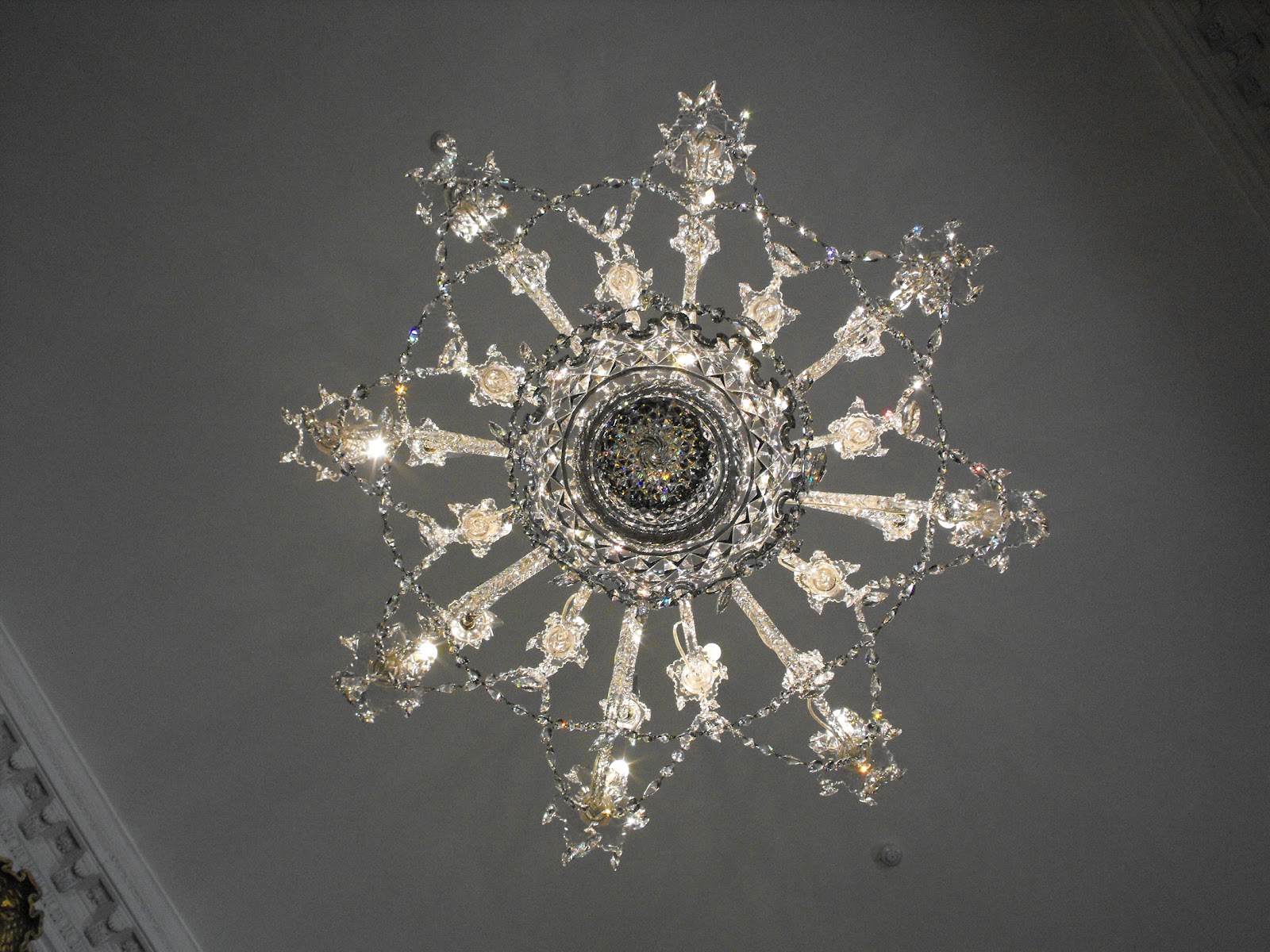
 This is a picture of the "snow flake" chandalier
 One of the many photos of paintings in the house

It also has a rather nice tea house where Cal had a 'cream tea' which is what they call a devonshire tea. Don't know why we call it 'devonshire' cause the jam always comes from the area & the cream is always Cornish clotted cream (yum!) Yes, bad for the diet but weekly bonus points are always saved for a cream tea every week, not that Cal gets one every week. Anyway, we won't be doing the gardens this weekend as they are closed because of the high winds forecast for Saturday - oh joy! 


Winchester

Saturday 9th June

So this is the entry that’s way out of date as we thought we’d keep some of the similar aspects all together. Winchester was one of the centres of power in the early kingdoms - both Wessex as well as the early Norman’s. The bottom line is that there were (or so we thought) a whopping 9 kings in the Winchester area - 6 in the Cathedral itself.


OK, so before the obligatory history lesson we thought we’d show you some of the Cathedral. We visited the treasury, where they have plates and cups dating back a very long way - this one is of a plate that was until recently the oldest paten in continuous use. It reads (translated) All things I make; By divine strength I rule; By Godliness I reform - dated c1230. 


We also saw the resting place of Jane Austin.


 The Holy Sepulcher Chapel


 A view from a higher vantage point
 
 This beautiful statue is in the Norman Crypt, which often floods :-)
 
Back to the Kings . . . . It was hard to determine who was the first of the Kings of England - was it William the Conquerer? or earlier - if earlier then who, as many of the “kings” were actually tribal chieftains. To cut a long story short, Edward the Great - a Wessex king is regarded as the first of the kings of England. His Old English name is Ælfrǣd, which means "elf counsel" (right, and that makes sense in a king!!!) and was King of Wessex from 871 to 899. He is the only English monarch to be accorded the title "the Great", and he also called himself "King of the Anglo-Saxons". One of the reasons why he is regarded as the first King of England is that he was regarded as a merciful man who encouraged education and improved his kingdom's legal system and military structure.

So who was at Winchester? So much history it’s hard not to tell - we met a lovely lady in the Cathedral as we were looking for the bones, and she was a wealth of information. Anyway, there are now six mortuary chests (used to be eight) in the cathedral that contain the remains of: 
Cynegils d.643 
Cenwalh d.672 
Egbert d.839 
Æthelwulf d.855 
Eadred d.955 
Eadwig (Edwy) d.959 
Canute the Great d.1035 
Harthacanute d.1042 
William II (Rufus) d.1100 


A list of the relics                                                   Cal outside the Alter with the chests

Cynegils and Cenwalh were bonuses for us as they weren’t really Kings of England, rather the first Kings of Wessex who invaded in the country in the early 7th century. King Canute (Knut) the Great was a Danish King (and one of the Kings of Wessex). The only reason we single him out is because he was attributed as saying: “Let all me know how empty and worthless is the power of kings, for there is none worthy of that name but God, whom heaven and earth and sea obey”. He died at Shaftesbury Abbey (see above) Pretty cool. William II (also known as Rufus) was the elder son of William the Conquerer, so we “met” our first Normal King as well!


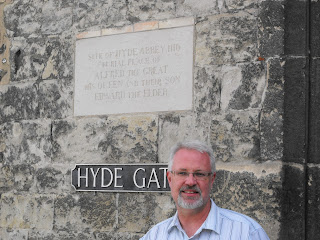
Outside the Cathedral, we had to walk to the remains of Hyde Abbey where Alfred the Great and his son Edward the Elder were originally buried. On the way we past Worthy Lane - not as good as our street “Wellworthy Drive” :-) 

Only the gatehouse remains to this day. - but that was good enough for us :-) 
Alfred the Great d.899 
Edward the Elder d.924 

Of course there was the (now obligatory) flower with ruin in background photo. Having visited Winchester, there are only five other pre-Norman kings to visit - including Harold Godwinson, who we could have seen when we visited Norfolk for the Queen’s jubilee (if we’d had our thinking caps on). The rest of the Kings and Queens are mainly in Windsor (St George Chapel) and Westminster.